
The problem most owners don't see
For most small business owners, accounts receivable is a back-office function. Invoices go out, payments come in, and when they come in late, someone has to stop what they are doing and chase them down. It works well enough until it doesn't.
The reality is less forgiving than it appears. 54% of small business owners report being affected by unpaid invoices, and the average small business spends 14 hours per week on administrative tasks related to collecting payments. That is nearly two full working days, every week, spent not growing the business but chasing money already owed.
Over the course of a year, that adds up to more than 700 hours of lost productivity. And the cost isn't only measured in time. Every dollar sitting in accounts receivable is a dollar not available for payroll, inventory, equipment, or any of the investments that actually move a business forward.
This is the problem Rowan's AR Agent was built to solve.
What the AR Agent does
Rowan's AR Agent automates the collection process. It monitors outstanding invoices, sends timely follow-up communications on the owner's behalf, and tracks payment activity in real time. It replaces the inconsistent, often awkward process of chasing payments manually with a structured collection workflow that is persistent but tailored to each customer.
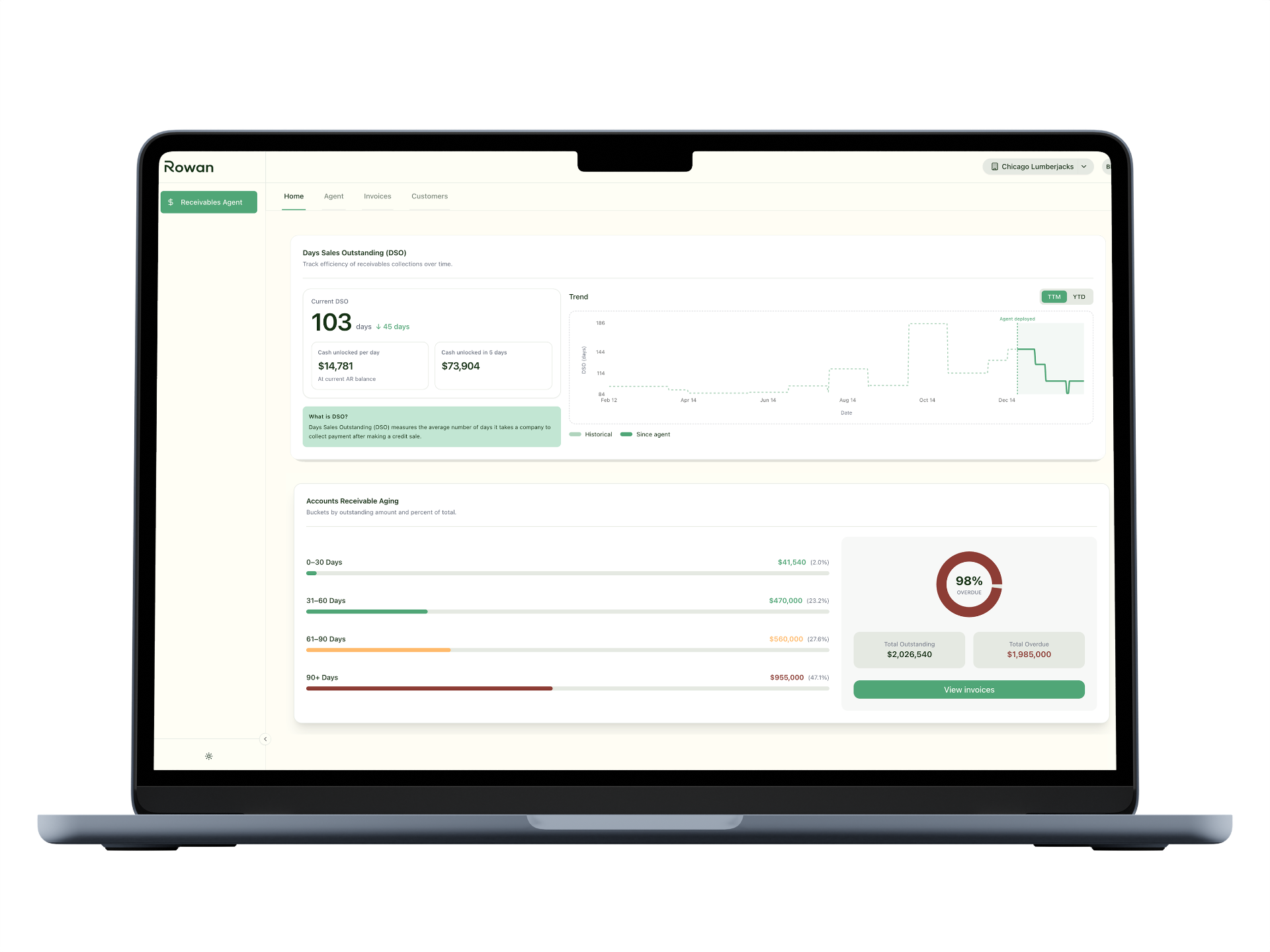
Most late payments aren't the result of unwillingness to pay. They are the result of invoices getting lost, forgotten, or simply falling to the bottom of someone's to-do list as time slips by. Consistent, timely follow-up is the single most effective way to accelerate payment without damaging customer relationships. The AR Agent handles this automatically.
The day-to-day benefits are immediate:
Improved cash flow. Less cash tied up in receivables. That freed-up capital is available for the owner to reinvest in the business, hold as a buffer against the unexpected, or simply put in their pocket.
Time back where it matters. If you are the one chasing payments, that is 14 hours per week you could spend growing revenue or improving operations. If you are lucky enough to have an office manager or team handling collections, that is 14 hours they can redirect toward helping you with other things.
The economics, in concrete terms
Consider a business generating $10,000,000 in annual revenue with $1,650,000 in accounts receivable. This implies a Days Sales Outstanding (DSO) of 60. DSO is simply how many days, on average, it takes you to receive cash for completed work. At 60 days, this business is carrying nearly two months of revenue that has been earned but not yet collected.
Figure 1: Impact of reducing Days Sales Outstanding
Today | Future | Change | |
Revenue | $10,000,000 | $10,000,000 | — |
Accounts Receivable | $1,650,000 | $1,225,000 | $425,000 |
Days Sales Outstanding | 60 | 45 | (15) |
By reducing DSO from 60 to 45 days, with no change in revenue, the business extracts $425,000 in cash that was previously locked inside the receivable balance. Same customers, same invoices. The money is simply collected faster, meaning fewer days of expenses need to be financed out of working capital.
Figure 2: Annual cost of collections
Needs | Cost |
Average Office Manager Salary | $60,000 |
Estimated Payroll Taxes & Benefits | 12.0% |
Fully Loaded Annual Cost | $67,200 |
Implied Hourly Cost | $32 |
Average Collection Hours / Week | 14 |
Total Collection Hours / Year | 728 |
Total Annual Cost of Collections | $23,520 |
At a fully loaded cost of $32 per hour, the 728 hours per year spent on collections costs the business $23,520, or far worse if you are doing it yourself. By automating the workflow, the AR Agent eliminates this cost entirely.
Figure 3: Total value created
Value | Total |
Incremental Cash Extracted (Figure 1) | ~$425,000 |
Savings on Collections (Figure 2) | ~$24,000 |
Total Value Created | ~$449,000 |
Average Monthly Value Creation | ~$37,000 |
In the first year alone, this real-world example shows approximately $449,000 in total value created, many times the cost of the AR Agent itself.
This is not aspirational. It is math, and we see it play out every day.
All of this applies to any business, whether or not a sale is on the horizon. But for an owner who is thinking about selling in the next three years, accounts receivable takes on a different significance. How you manage it today will directly determine how much cash you walk away with at closing.
Why accounts receivable matters in a sale
Most M&A transactions for businesses are structured on a cash-free, debt-free basis, inclusive of a normalized level of working capital. In practice, this means the purchase price includes enough working capital to fund ongoing operations without additional investment from the buyer. Accounts receivable is typically one of the largest components of that balance.
This is where the mechanics become critical, and where the vast majority of sellers lose money without ever knowing it.
The AR Agent addresses three specific problems that arise in a sale, each with a direct impact on what the seller takes home at closing.
1. Reducing the trailing 12-month average AR balance
The normalized working capital target is typically calculated as the trailing 12-month average of each working capital line item. The higher your average AR balance over the prior year, the more cash you are required to leave behind at closing.
Every dollar that the average AR balance is reduced by converting from working capital into cash. One more dollar the seller keeps. One less dollar left behind. This is not theoretical. It is a direct, dollar-for-dollar shift in closing proceeds.
The AR Agent creates this outcome by compressing collection cycles and reducing total receivables outstanding over time, which lowers the trailing average that determines the working capital target. An owner who deploys it 12 to 24 months before a sale will walk away from the closing table with meaningfully more cash than one who does not.
2. Reducing 90+ day aged receivables
Most buyers will require that receivables aged beyond 90 days be written off or excluded from the working capital calculation at closing. The specific treatment depends on the purchase agreement, but the outcome for the seller is unfavorable in either case:
Scenario | What happens | Seller impact |
90+ day receivables are excluded from working capital | The receivables are carved out entirely. The buyer retains the right to collect on them post-closing. | The seller receives no credit at closing and forfeits the economic benefit of collection to the buyer. |
90+ day receivables are included in working capital | The receivables are counted in the closing balance, but the buyer can deduct them if not collected within a specified period. | The seller receives initial credit but faces a clawback risk, creating uncertainty in final proceeds. |
Either way, 90+ day receivables at closing represent cash that the seller gives up entirely or receives only conditionally, subject to collection outcomes they no longer control. The AR Agent prevents this by maintaining consistent collection pressure across the entire receivable book, keeping invoices from aging into the 90+ day category in the first place.
3. Building a defensible data foundation for working capital negotiations
How accounts receivable is defined and measured in the purchase agreement determines who bears the economic benefit or burden. Buyers and their advisory teams will draft this language to favor their side, often at the seller's direct expense. The most effective defense is data.
An owner who enters a sale process with 12 to 24 months of well-documented AR activity, including aging trends, collection patterns, and clearly defined accounting policies, is in a fundamentally stronger position to push back. The AR Agent builds this data set as a byproduct of doing its job. Every follow-up, every payment, every aging movement is tracked and recorded.
That record puts the seller's methodology on solid footing and leaves less room for ambiguity, which means fewer disputes at closing and less opportunity for a buyer's team to exploit gaps in the seller's records.
Running a better business today. Achieving a better outcome tomorrow.
The work required to run a healthier business day to day is the same work that positions an owner for a stronger outcome in a sale.
These are not separate objectives. They are the same objective, viewed from two different time horizons. This is the philosophy behind Rowan's approach to value creation: tools that make the business stronger from the moment they are deployed, while simultaneously preparing it for its next chapter.
The best time to start was yesterday. The second best time is today. Learn more about our AR Collect Agent today.